SSC CGL Preparation Strategy: Complete Guide to Crack Both Tiers

A
admin
Content Team · Howk
Jun 2, 2026 16 min read

The SSC CGL is not just another competitive exam — it is a gateway to some of the most respected Group B and Group C positions in the Central Government, from Inspector in Income Tax and CBI to Assistant Section Officer and Tax Assistant. Every year, over 25 lakh candidates register for it. The commission announces thousands of vacancies each cycle across Group B and Group C posts, but the competition-to-vacancy ratio remains steep — and the margin between clearing the cut-off and missing it can be as thin as one or two correct answers. This guide is not a surface-level overview. It walks you through the entire preparation process — understanding the exam structure, building a subject-wise plan, managing your time across both tiers, and using the right practice approach to actually build the accuracy and speed the exam demands.

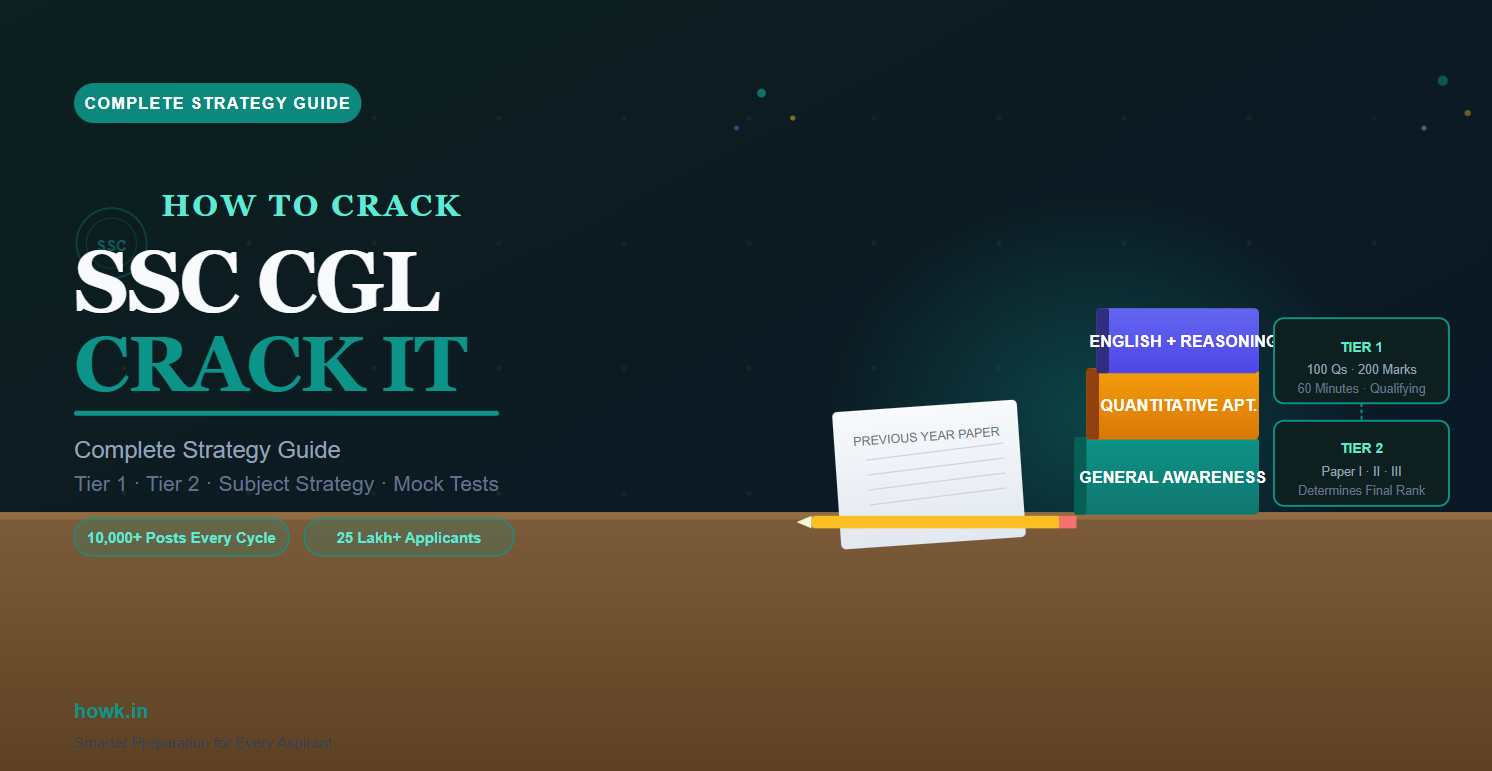
SSC CGL preparation strategy guide — books, question papers, and study plan on a desk
10,000+ Vacancies announced each cycle
2 Tiers Tier 1 (Qualifying) + Tier 2 (Merit)
100 Qs Tier 1 — 200 marks, 60 mins
0.50 Negative marking per wrong answer
25 Lakh+ Applicants each year
Step 01

Understand the Exam Structure Before You Open a Single Book

One of the most common preparation mistakes is jumping straight into studying topics without understanding how the exam actually works. The SSC CGL has a two-tier structure, and how you prepare for each tier is very different. Tier 1 is a computer-based qualifying exam consisting of 100 questions across four sections — General Intelligence & Reasoning (25 questions, 50 marks), General Awareness (25 questions, 50 marks), Quantitative Aptitude (25 questions, 50 marks), and English Language & Comprehension (25 questions, 50 marks). You get 60 minutes for the entire paper. There is negative marking of 0.50 marks per wrong answer. Critically, your Tier 1 score does not count in the final merit list — it is only used to qualify for Tier 2. This means your goal in Tier 1 is to clear the cut-off comfortably, not to max out the score. Tier 2 is where selection happens. Paper I is compulsory for all posts and is divided into three sections: Mathematical Abilities and Reasoning, English Language & Comprehension, and General Awareness and Computer Knowledge. Paper II and Paper III are post-specific, relevant only to candidates applying for Junior Statistical Officer (JSO) and Assistant Audit Officer/Assistant Accounts Officer (AAO) posts respectively. Your final rank is based entirely on your Tier 2 performance.
Key strategic insight: Because Tier 1 is only qualifying, don’t over-invest time trying to perfect it. Aim to clear the cut-off with a safe margin and reserve the bulk of your depth preparation for Tier 2, which determines your post and rank.
Tier Questions / Marks Duration Purpose
Tier 1 100 Qs / 200 marks 60 minutes Qualifying only
Tier 2 – Paper I Compulsory for all posts Session I + II Final merit
Tier 2 – Paper II For JSO applicants Post-specific
Tier 2 – Paper III For AAO applicants Post-specific
Step 02

Build a Subject-wise Strategy — Not a Generic Study Plan

Every subject in SSC CGL has a different preparation approach. Treating them all the same — spending equal time on each section regardless of your current level — is one of the biggest efficiency killers in exam preparation. Here is how to approach each section. Quantitative Aptitude — This section trips up the most candidates, but it is also one of the most consistently scoreable areas once you have the right groundwork. The Tier 1 questions are set at Class 10 level; Tier 2 goes deeper. Priority topics include Arithmetic (Percentage, Profit & Loss, SI & CI, Time & Work, Time, Speed & Distance), Algebra, Geometry, Mensuration, and Data Interpretation. Focus on accuracy over speed initially — wrong answers cost you 0.50 marks each, so attempting 18 correct questions beats attempting 22 and getting 5 wrong. Build formula recall through daily practice, not through passive reading. General Intelligence & Reasoning — This is the highest-scoring section for most prepared candidates because it does not require rote learning — it requires pattern recognition. Analogy, Classification, Series (Number and Letter), Coding-Decoding, Blood Relations, Direction Sense, and Syllogisms form the bulk of Tier 1 questions. Non-verbal reasoning (Mirror images, Paper Folding, Embedded Figures) is important but takes less time per question once practiced. The best way to improve here is not theory — it is solving previous year questions until the patterns become instinctive. English Language & Comprehension — This section rewards consistency. There is no cramming approach that works here. Vocabulary (Synonyms, Antonyms, Idioms & Phrases, One-word Substitution), Grammar (Error Spotting, Sentence Correction, Para Jumbles, Fill in the Blanks), and Reading Comprehension all need regular, daily exposure. Read one editorial every morning — not to understand the news, but to notice grammar, sentence structure, and vocabulary in context. Maintain a vocabulary journal and review it using spaced repetition. General Awareness — This is the section that divides the shortlisted from the rest in Tier 1. It is entirely memory-based, and the good news is that the syllabus is well-defined. Static GK (History, Geography, Polity, Economy, Science) forms the base. Current Affairs from the last 6–8 months fills the remainder. A structured approach works best: cover static GK through NCERT books first, then layer in current affairs through monthly capsules. Revise using flashcards or the active recall method — passive reading of GK notes does not stick.
High-priority topics by weightage: In Tier 1, General Awareness typically produces the quickest marks-per-minute ratio because questions can be answered in 15–20 seconds if you know the answer. Invest accordingly — more revision time on GK pays faster dividends than extra Quant practice at the same preparation level.

Step 03

A Realistic Study Plan That Actually Holds Up

Most study plans fail not because they are wrong, but because they are built for an ideal version of the aspirant — 10 uninterrupted hours every day, no commitments, peak energy throughout. Real preparation does not look like that, and a plan that does not account for real life gets abandoned within two weeks. A workable plan for SSC CGL requires roughly 5–6 hours of productive study per day, spread across morning and evening slots if you have other responsibilities. For fresh candidates, 6–8 months of structured preparation is sufficient. For repeat candidates, 3–4 months of targeted revision and mock test practice may be enough.
Phase 1 — Foundation (Months 1–3)
  • Complete Tier 1 syllabus topic by topic
  • NCERT base for GK (Class 6–12)
  • Formula sheets for Quant
  • 1 topic-wise practice set per topic before moving on
  • Vocabulary: 15 new words daily
Phase 2 — Application (Months 4–5)
  • Full Tier 2 Paper I syllabus coverage
  • Previous year question papers (last 5 years)
  • 2 mock tests per week (Tier 1 level)
  • Detailed error log for every mock
  • Begin current affairs consolidation
Phase 3 — Revision + Mock Drill (Month 6+)
  • 3–4 full mocks per week
  • Spend more time analyzing mocks than taking them
  • Targeted revision of weak sub-topics only
  • GK rapid revision — daily 100 questions
  • Speed drills for Reasoning and English
A note on working candidates: If you are preparing alongside a job or college, do not try to compress the same number of topics into fewer hours. Instead, prioritise Reasoning and English in the morning (they need active focus), GK revision in commute time via audio/flashcards, and Quant in the evening when you have a desk. 4 focused hours beats 7 distracted ones every time.
Step 04

Previous Year Papers — The Most Underused Preparation Tool

SSC CGL follows a very clear pattern year after year. The question types, the difficulty distribution, the traps in Reasoning, the type of RC passages used in English — all of it repeats with minor variations. Previous year question papers are not just practice material; they are a map of what the exam actually looks like versus what coaching notes tell you it will look like. Most aspirants solve previous year papers once, check the answers, and move on. That is a waste of the most valuable study material available. The right approach is to treat each paper like a diagnostic test. Time yourself strictly. After completing the paper, analyse every single question — not just the wrong ones. For every correct answer, confirm that you actually knew it (not guessed it). For every wrong answer, identify the exact reason — conceptual gap, silly mistake, misread question, or time pressure. This classification tells you exactly where to direct your next week of preparation. Cover the last 5 years at a minimum. If you can find TCS (Exam agency) released papers from prior cycles, those are the most authentic material available since they come directly from the question bank used in actual SSC exams.
Topic-wise drilling after each paper: Identify the 2–3 question types that cost you the most marks in a paper. Before moving to the next mock, do a focused practice set on exactly those types. This closes gaps before they compound. You can start your topic-wise practice at howk.in/topics — drill by topic before the weaknesses from one paper carry over to the next.
Step 05

Mock Tests — How to Use Them Right

Taking mock tests is necessary. But how you use the results is what separates candidates who improve steadily from those who stagnate at the same score for months. The most common approach — take a mock, note the score, feel motivated or demotivated, repeat — does not produce improvement. Your score in isolation tells you almost nothing. It does not tell you whether your wrong answers were from knowledge gaps or careless errors. It does not tell you whether you left too many questions or attempted recklessly. It does not tell you if your time distribution across sections cost you marks even on topics you know well. After every mock test, spend at least as much time on analysis as you spent taking it. A 60-minute Tier 1 mock should be followed by 60–90 minutes of review. Go question by question. Mark each attempted question as: correct and confident, correct but guessed, incorrect but knew it, incorrect due to concept gap, or left unattempted. Over three to four mocks, these marks reveal patterns — your personal weak areas — that no syllabus list can tell you. Treat your cut-off strategy seriously too. SSC CGL cut-offs vary by category and year. Tracking cut-off trends for your category across the last three cycles gives you a realistic target score and helps you decide how many questions to attempt versus skip in each section.
  • Attempt mocks in real exam conditions — no pausing, phone away, full timer on
  • Track your accuracy per section across every mock in a simple spreadsheet
  • Identify recurring wrong question types — these are your priority revision topics
  • Monitor time per section — if one section consistently drains your time, adjust your exam-day sequence
  • Never take two mocks back-to-back without analysis in between
  • Compare your attempted questions vs. correct questions — high attempts with low accuracy is worse than fewer, careful attempts
Step 06

Negative Marking Strategy — When to Attempt, When to Leave

The 0.50 negative marking rule in SSC CGL changes the decision calculus significantly compared to exams with no penalty. Many aspirants either ignore it completely (attempting everything) or become too conservative (leaving too many questions out of fear). Both extremes cost marks. The simple rule: attempt a question only if you can confidently eliminate at least two options. If you are down to two choices and have a genuine reason to prefer one, the expected value of attempting is positive even with negative marking. If you have no basis to eliminate any option, leave the question — a random guess on a four-option question has an expected score of −0.125 marks, which adds up painfully across a full paper. Different sections demand different thresholds. In Reasoning and English, where elimination is usually possible from your knowledge, attempt aggressively. In General Awareness, your knowledge is either there or it is not — do not guess on Static GK questions where you have zero recall. In Quantitative Aptitude, if a calculation feels off or is taking longer than 90 seconds, mark it for review and move on rather than spending time on an uncertain answer.
The rank list is not built on how many questions you attempted. It is built on how many you got right. A disciplined candidate who attempts 80 questions with 90% accuracy will almost always outscore someone who attempts 95 questions with 70% accuracy.
Step 07

General Awareness — The Section That Can Change Your Rank

General Awareness is the single highest-leverage section in Tier 1. A candidate who has built strong GK can attempt 20–22 questions in under 8 minutes, leaving more time for Quant and Reasoning where questions require calculation. A candidate who is weak in GK either wastes time guessing or leaves too many questions unattempted. The SSC CGL GK syllabus covers History (Ancient, Medieval, Modern India), Geography (Indian and World), Polity (Indian Constitution, Government structure), Economy (basic terms, Budget, RBI, banking), Science (Physics, Chemistry, Biology — Class 9–10 level), and Current Affairs (last 6–8 months). The static GK portion is finite and coverable — it just requires structured revision, not endless re-reading. Build your static GK from NCERT textbooks for Classes 6–10. They are written clearly, are SSC-aligned, and cover the exact depth the exam tests. Supplement with a standard SSC GK compilation. For current affairs, a monthly capsule from a reliable source is sufficient — you do not need to read the news daily if you are short on time, but do not skip the monthly consolidation entirely.
The 100-a-day GK drill: In the final month before Tier 1, do 100 GK questions every day — a mix of static and current affairs. This keeps memory fresh, builds speed on factual questions, and helps you identify topics that keep slipping out of your recall. Combine this with topic-wise practice on howk.in/topics to drill specific GK topics rather than just guessing through mixed sets.
Step 08

Tier 2 Preparation — Where Ranks Are Actually Made

Most aspirants focus heavily on Tier 1 preparation and then scramble to prepare for Tier 2 after results. This is the wrong sequence. Tier 1 is a filter — Tier 2 is the actual selection exam. Start Tier 2 preparation in parallel with Tier 1, even if at lower intensity, so you are not starting from scratch after qualifying. The Tier 2 Quantitative Aptitude section goes significantly deeper than Tier 1. Advanced Algebra, Trigonometry, and Data Interpretation with complex graphs appear at a higher difficulty level. English in Tier 2 includes longer passages, more complex vocabulary, and a greater number of grammar-based questions. The General Studies component covering Finance, Economics, and Computers requires specific preparation that is distinct from Tier 1 GK. For candidates targeting the AAO post, Paper III on Finance and Accounting demands a dedicated preparation track. If that post is your goal, begin this preparation early — it is too detailed to rush in the final weeks.
Tier 2 Component Key Focus Areas Common Pitfall
Mathematical Abilities Advanced Arithmetic, Algebra, Trigonometry, DI Leaving DI for last — it is the fastest marks source
English Comprehension Reading Comprehension, Grammar, Para Jumbles Rushing RC passages — read once carefully, answer fast
General Awareness Current Affairs, Indian Economy, Polity, Science Skipping Economy — it has consistent question weightage
Computer Knowledge Basic hardware, software, MS Office, Internet Treating it as guaranteed marks without revision

Build Your Foundation Topic by Topic

The fastest way to close your weak areas is targeted, topic-wise practice — not another full mock test. Howk organises questions by subject and topic so you can drill exactly what you need, when you need it. Practice Topic-wise on Howk →

Cracking SSC CGL Is a Process, Not a Sprint

With over 25 lakh candidates registering every cycle and roughly 14,000 posts on offer, the competition-to-vacancy ratio in SSC CGL is intense. But the exam is also one of the most predictable in India — the syllabus is fixed, the pattern is consistent, and previous year papers give you an accurate picture of what to expect. That predictability is your advantage if you use it. The candidates who struggle are usually the ones who study everything equally, skip mock test analysis, avoid their weak subjects until it is too late, and treat GK as an afterthought. The candidates who crack it follow a structured plan, close weak areas systematically through targeted practice, take negative marking seriously, and spend as much time analysing their performance as studying new material. Start with the section that needs the most work. Build your foundation, then layer in mock tests and analysis. Give Tier 2 the respect it deserves from day one. And do not wait for the “perfect time” to start — the exam does not wait, and neither should your preparation.
A
Written by
admin

Part of the Howk content team — creating exam prep resources for SSC, UPSC, Banking, Railways and more. We help aspirants study smarter and score higher.

UPSC Prelims : Last 30 Days Preparation Strategy

Leave a Reply

Your email address will not be published. Required fields are marked *