
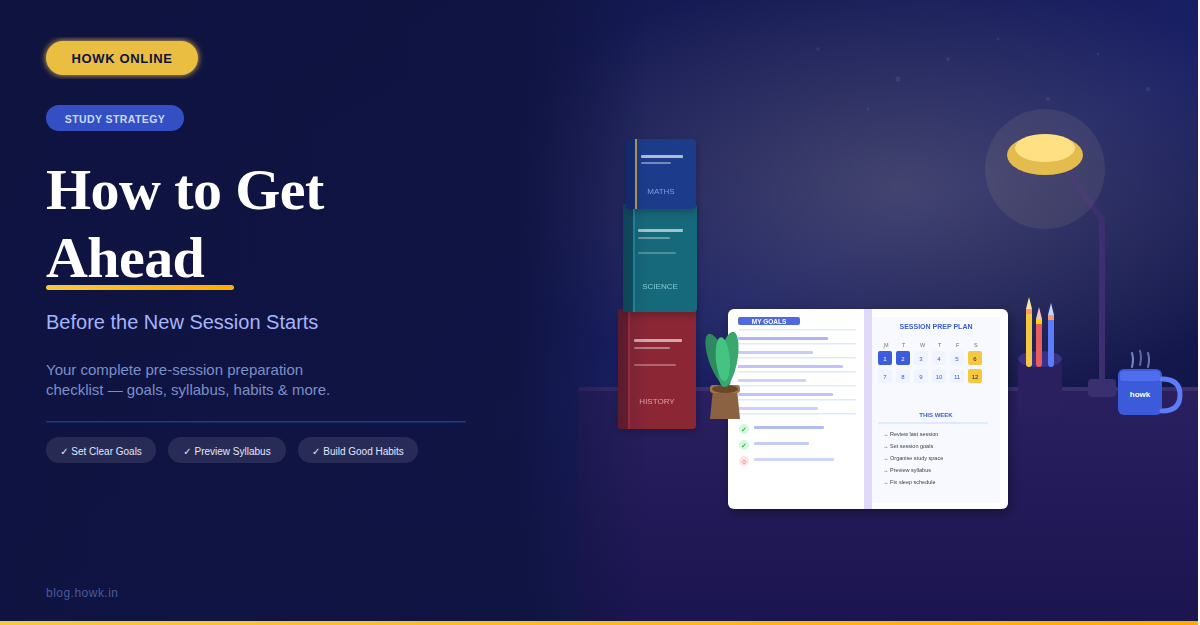
Why the Pre-Session Window Matters So Much
The gap between one academic session ending and the next beginning is one of the most underused stretches of time in a student’s calendar. Most students treat it as pure leisure — and while rest is absolutely important, a few intentional hours spread across this window can change your entire trajectory for the year ahead.
Think of it this way: when a session starts, every student is on the same starting line. Moreover, teachers begin covering new material almost immediately, and if you have not yet settled your mindset, organised your materials, or previewed even a little of what is coming, you spend the first few weeks just catching up. In contrast, students who use the pre-session window arrive already oriented — and that head start compounds over time.
Additionally, the pre-session period is quieter, lower-pressure, and free from homework deadlines. Therefore, it is the ideal time to do the reflective and preparatory work that is nearly impossible to do once the term is in full swing.
Knowing what is coming reduces first-week anxiety and helps you absorb lessons faster from day one.
Small preparation tasks completed in advance mean you start the session already moving, not standing still.
Setting goals before the session starts means every week has direction, rather than just responding to what teachers assign.
Review Last Session Honestly — Before Moving On
One of the most important things you can do before a new session is to look back at the previous one clearly and honestly. Furthermore, this does not mean dwelling on failures — it means learning from them so you do not repeat the same patterns.
Take a notebook and spend 20–30 minutes answering a few key questions. Write down which subjects felt strong and which felt shaky. Note which study habits served you well and which ones consistently let you down. Additionally, think about where you lost marks — was it content gaps, time management in exams, or careless errors?
- Review your previous exam papers and identify recurring mistakes
- List subjects where your foundation feels weak — these need early attention
- Note which study habits worked and which did not
- Acknowledge what you did well — do more of this next session
- Do not skip this step because it feels uncomfortable — that discomfort is exactly where growth lives
- Do not spend more than 30 minutes here — reflection is a launchpad, not a loop
Set Specific, Meaningful Goals for the New Session
Vague intentions like “study more” or “do better this year” are not goals — they are wishes. In fact, research consistently shows that specific, written goals are dramatically more likely to be achieved than ones kept only in your head. Therefore, before the session begins, take time to set goals that are clear, realistic, and personal to you.
Break your goals into three levels: what you want to achieve by the end of the full session, what you want to achieve by the midterm stage, and what you want to do in the very first month. This layered approach keeps you from feeling overwhelmed while ensuring that long-term ambitions are supported by short-term actions.
- Build a consistent daily study habit
- Complete all reading for core subjects
- Attend every class with full focus
- Attempt at least one practice quiz per week
- Complete one full revision of each subject
- Identify and fill all knowledge gaps
- Improve on your weakest subject’s score
- Maintain your study schedule consistently
- Hit a specific target score or percentage
- Feel confident going into final exams
- Have no last-minute revision panic
- Complete all syllabus topics in advance
Organise Your Study Space and Materials
Your physical environment has a direct effect on your ability to focus. A cluttered, disorganised study space creates a cluttered, distracted mind. Therefore, one of the most impactful things you can do before the session begins is to get your study area and materials in order — not because tidiness is the point, but because organisation removes friction.
When everything has a place, you spend zero mental energy looking for things. Furthermore, when your books, notes, stationery, and resources are ready before day one, you can walk to your study table and immediately get to work, rather than spending the first ten minutes hunting for a pen or last year’s notes.
- Clear your study table completely and reorganise with only what you need
- Buy or gather all textbooks, notebooks, and stationery before the session starts
- Create separate folders or notebooks for each subject
- Set up a digital folder structure if you use a phone or laptop for study
- Make sure your study space has good light and minimal distractions
- Do not use the same space for entertainment and study — your brain needs to associate the desk with focus
Preview the Syllabus — Even Just 30 Minutes Per Subject
You do not need to study everything before the session starts. However, even a brief preview of each subject’s syllabus can make a remarkable difference to how quickly you absorb material once teaching begins. In fact, neuroscience tells us that the brain learns new information faster when it already has a loose framework to attach it to — this is known as priming.
Spend 20–30 minutes per subject simply reading through the chapter headings, scanning the key topics, and noting any areas that overlap with what you already know. Moreover, write down two or three questions you are curious about in each subject. This turns passive reading into active enquiry, which means your brain will be alert and looking for answers from your very first class.
| Subject | Preview Focus | Time Needed |
|---|---|---|
| Mathematics | Scan chapter topics, note any formulas you remember from before | 30 minutes |
| Science / Biology / Physics / Chemistry | Read unit headings, recall prior concepts that connect to new topics | 20–30 minutes each |
| History / Social Science | Skim era names, key events, and chapter titles | 20 minutes |
| Languages (Hindi / English) | Read prescribed text titles and note unfamiliar vocabulary | 20 minutes |
| Geography | Note the regions and themes covered, link to current events you know | 20 minutes |
“Preparation does not mean knowing all the answers. It means showing up with the right questions already forming in your mind.”— A principle every topper quietly lives by
Fix Your Sleep and Wake Schedule Before Day One
One of the most overlooked aspects of session preparation is the body’s internal clock. If you have spent the break sleeping late and waking up mid-morning, walking into a school or college schedule on the first day will feel like jet lag. Additionally, decision fatigue is real — a tired brain makes worse choices, retains less information, and gives up on difficult problems sooner.
Therefore, start shifting your sleep schedule at least one week before the session begins. Move your bedtime 15–20 minutes earlier each day and set your alarm for the same time you will need to wake up once class starts. This gentle adjustment is far easier on the body than a sudden reset on the first morning.
Move bedtime 15–20 minutes earlier each day for a week. Sudden changes rarely stick and leave you more exhausted.
Set your alarm for the same time every day, including weekends. Consistency trains your body’s rhythm far faster than willpower alone.
No screens in the hour before bed. Reading or light stretching instead signals your brain that it is time to wind down.
Build a Rough Weekly Study Plan — Before You Need It
You do not need a detailed, hour-by-hour timetable before the session begins — that level of rigidity often collapses within the first week anyway. What you do need, however, is a rough skeleton: a sense of which subjects you will focus on which days, when your peak concentration hours are, and where you will fit in revision and practice.
Moreover, having even a loose structure means you arrive at your study table with a default plan rather than spending ten minutes deciding what to study. In fact, that decision fatigue at the start of a study session is one of the most common reasons students end up scrolling their phone instead of opening a book.
- Focus on mathematics or the subject you find hardest
- Fresh mind at start of week — use it for difficult topics
- Science subjects or language-heavy reading
- Mid-week energy — good for conceptual depth
- Lighter review or practice questions
- End the week with a sense of completion
- Full weekly revision — revisit all subjects briefly
- Attempt a mock test or timed practice set
Address Your Weakest Subject Head-On
Every student has that one subject — the one that shows up in their nightmares and drags down their overall performance. Additionally, most students avoid it during the break, which means they arrive at the new session with the same weakness and the same dread. Therefore, the pre-session period is actually the perfect time to begin changing your relationship with that subject.
You do not need to master it before class begins. Moreover, you do not need to study it for hours. Simply spend 15–20 minutes every other day reviewing the most fundamental concepts — the building blocks that underpin everything else. When you arrive at class having already revisited the basics, the new material becomes far less intimidating.
- Identify your weakest subject honestly — do not skip this step
- Find the most fundamental chapter or concept and start there
- Use 15–20 minute sessions — short enough to stay consistent without feeling overwhelmed
- Use online videos, diagrams, or past question papers to revisit basics in a fresh way
- Do not try to revise the entire subject before session starts — that is a recipe for burnout, not improvement
- Do not avoid the subject entirely because it is uncomfortable — avoidance always makes it worse
Strengthen Your Reading and Note-Taking Habits
Two skills determine how quickly you learn in class more than almost any other: how well you read and how effectively you take notes. In fact, most students have never been formally taught either skill — they simply read the way they always have and write down whatever seems important in the moment. Therefore, the pre-session period is a great time to deliberately upgrade both.
For reading, practice active reading: before you begin a passage, scan the headings and ask yourself what you already know about the topic. While reading, pause at the end of each paragraph and try to summarise it in one sentence in your own words. Furthermore, after finishing a page, write down the single most important idea without looking back.
For note-taking, experiment with the Cornell Method — dividing your page into a narrow left column for key questions and a wide right column for notes, with a summary at the bottom. This format forces active engagement rather than passive copying, and additionally makes revision far faster because your key questions are already written.
| Habit | What Most Students Do | What Works Better |
|---|---|---|
| Reading | Read from start to finish, hoping it sticks | Preview → Read actively → Summarise in own words |
| Note-taking | Copy what the teacher says or writes | Write key ideas in own words, leave space for questions |
| Revision | Re-read notes the night before an exam | Test yourself from memory, then check what was missed |
| Difficult concepts | Skip past them and hope they do not appear in exams | Flag them immediately, seek clarification the same day |
Your Pre-Session Checklist — The Full Action Plan
To bring everything together, here is a clear, actionable checklist you can work through before the new session begins. Moreover, you do not need to complete all of this in a single sitting — spread it across a week or two, and additionally treat each item checked off as a real win. These small actions, taken consistently, are what separate students who drift through a session from those who own it.
- Complete an honest review of the previous session — what worked, what did not
- Write down your goals for this session at three levels: first month, midterm, and end of year
- Organise your study space and gather all required materials
- Spend 20–30 minutes previewing the syllabus for each subject
- Begin adjusting your sleep and wake schedule one week in advance
- Sketch a rough weekly study plan with subject allocation per day
- Spend at least 3–4 short sessions on your weakest subject’s fundamentals
- Read about or practise one improved study skill — active reading or structured note-taking
- Share your main goal with someone who will check in on you
- Set up a practice habit — even one quiz or question set per week from day one
Turn Preparation into Practice
The best way to get ahead is to start testing yourself before anyone else does. Explore thousands of practice questions across all subjects and start building your edge right now.
Start Practising on Howk →The Session Belongs to Those Who Begin Before It Does
Getting ahead before the new session starts is not about burning through your break or sacrificing rest. In fact, it is about using a small amount of intentional time to arrive in the right state — organised, oriented, and already in motion.
The students who reflect honestly, set clear goals, sort their materials, preview their syllabus, fix their sleep, and face their weakest subject early do not outperform their peers because they are more intelligent. Moreover, they simply make better use of the time that everyone else wastes waiting for the session to tell them what to do.
Therefore, start today — even one item from the checklist above. That first step is what separates a session that happens to you from one that you make happen.