
Most students preparing for competitive exams are not struggling because they study too little — they’re struggling because they study the wrong way. Re-reading the same chapter five times, highlighting every sentence, or passively watching lecture videos for hours gives you the feeling of progress without the results. The students who consistently crack tough exams are not necessarily the ones who put in the most hours. They’ve simply figured out how to make every hour count. If you’re preparing for JEE, NEET, UPSC, SSC, CUET, or any competitive exam, these five techniques are the ones that actually move the needle — backed by research and used by top scorers across the country.
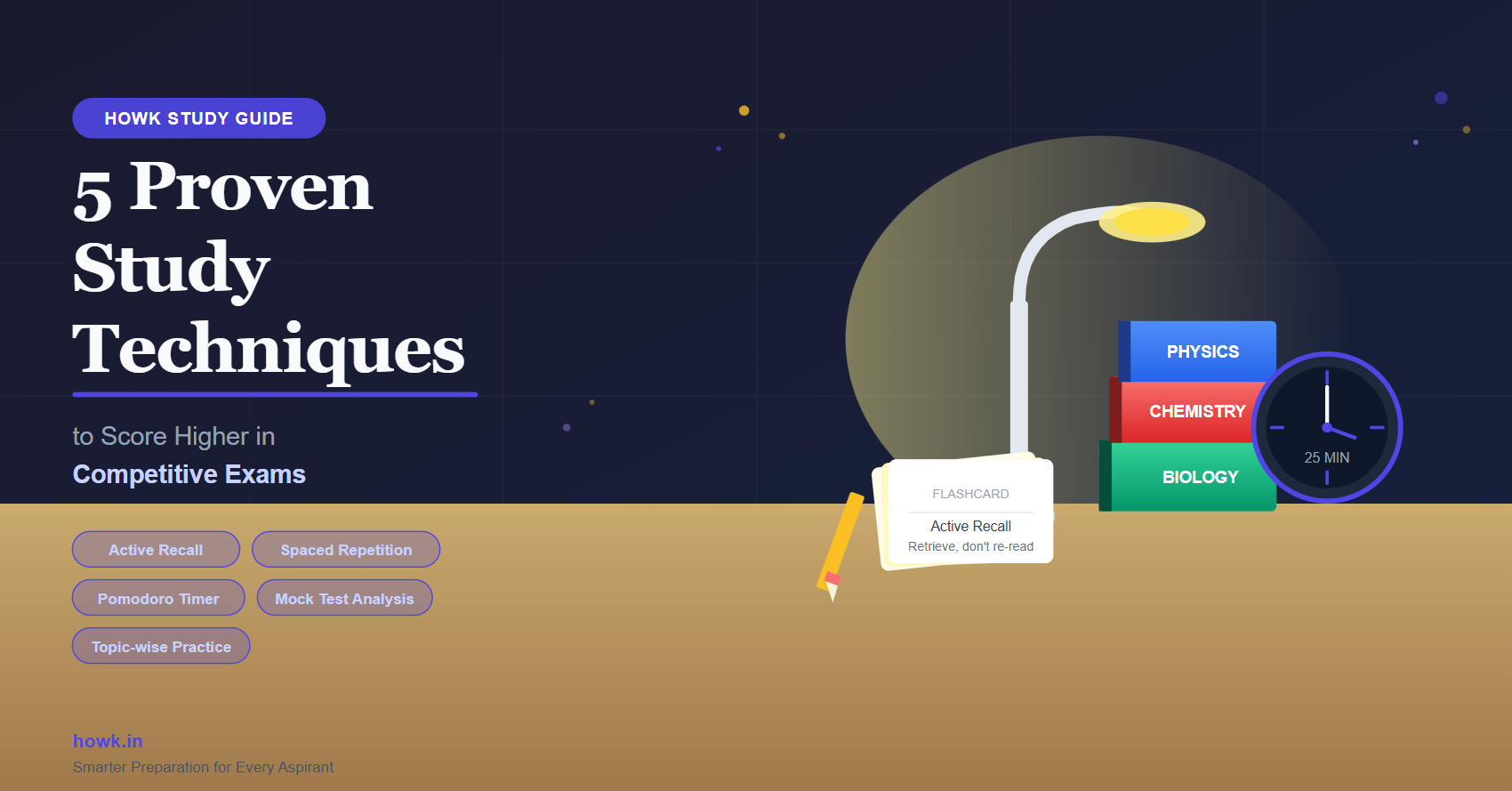
Technique 01
Active Recall — Stop Re-reading, Start Retrieving
Here’s a habit almost every student has: finish reading a chapter, feel like you understood it, and then move on. The problem is that reading feels familiar, and our brain mistakes familiarity for knowledge. Familiarity doesn’t help you in an exam hall where there’s a blank answer sheet in front of you.
Active recall flips the process. Instead of reading your notes again, you close the book and force yourself to write down — or say out loud — everything you remember from that topic. It’s uncomfortable, and that discomfort is exactly the point. Every time your brain struggles to retrieve a piece of information, it strengthens that memory pathway.
In practice, this looks like: reading a topic once, then writing a short brain-dump from memory, answering flashcards without looking at the answer, or explaining the concept to yourself as if you’re teaching it. It takes more effort than passive revision, but studies show it produces 50–60% better long-term retention.
Try this today: After studying any topic for 30 minutes, close your notes and write down every concept, formula, or point you remember. Then compare with your notes. The gaps you find are your actual weak areas — not what you think your weak areas are.
Technique 02
Spaced Repetition — Fight the Forgetting Curve
German psychologist Hermann Ebbinghaus mapped out something called the forgetting curve over a century ago, and yet most students still study as if it doesn’t exist. The forgetting curve shows that without any review, you forget roughly 50–70% of new information within a day or two. That means cramming a topic once and moving on is essentially studying it for nothing.
Spaced repetition solves this by scheduling your reviews at increasing intervals — so you revisit a topic just before your brain is about to forget it. A simple system looks like this: review a topic 1 day after first learning it, then again after 3 days, then after 1 week, then after 2 weeks. Each time you recall it successfully, the next interval becomes longer. Over time, topics that once needed weekly review start needing only monthly review.
You don’t need any special software to get started. A simple notebook with dates — or even just flagging topics in your planner — works perfectly well. The key is that you’re not picking topics to revise based on what you enjoy or remember easily. You’re revising based on a schedule.
Practical tip: Keep a revision log. When you first finish a topic, write the date and set reminders for: Day 1, Day 4, Day 10, Day 21. This one habit alone can significantly reduce the time you spend on re-learning topics you thought you already knew.
Technique 03
The Pomodoro Technique — Protect Your Focus
Sitting at your desk for three hours while your phone is within arm’s reach, your mind occasionally wandering to lunch plans and Instagram notifications, is not a three-hour study session. It’s a 45-minute study session with a lot of background noise around it.
The Pomodoro Technique was built around one idea: the human brain is not designed for uninterrupted hours of deep focus. It works in bursts. The technique asks you to study in 25-minute blocks of complete, no-distraction focus — phone face down, notifications off, no side tabs open — followed by a 5-minute break where you step away from the material completely. After four such blocks, take a longer break of 20–30 minutes.
What makes this work is not just the structure but the commitment. During those 25 minutes, you are not checking messages. You are not taking a “quick look” at anything. Those 25 minutes belong entirely to your preparation. The break is non-negotiable too — your brain needs it to consolidate what you’ve just processed.
Most students who try this find that 4–5 focused Pomodoros get more done than an entire unfocused afternoon. Track your Pomodoros each day and you’ll have a real measure of your productive study time — not just the hours you were physically present at your desk.
One adjustment for exam prep: For subjects requiring deep problem-solving — like Physics or Maths — try 45-minute blocks instead of 25. The mental warm-up phase for these subjects can take 10–15 minutes, so shorter blocks may cut you off just as you’re getting into a good flow.
Technique 04
Mock Test Analysis — The Step Students Skip
Taking mock tests is good. Most serious aspirants do it. But here’s the uncomfortable truth: most students spend one hour taking a mock test and about fifteen minutes “checking” the answers. They note the score, feel good or bad about it, and move on. That is not how mock tests should work.
Your score on a mock is useful information, but the real value is in the analysis that follows. Every wrong answer is a clue. Was it a conceptual gap — you didn’t know the topic well enough? Was it an application gap — you understood the concept but couldn’t use it under pressure? Was it a silly mistake — you knew the answer but misread the question or rushed through it? Was it a time management failure — you ran out of time and guessed? Each of these has a completely different fix, and treating all wrong answers as the same problem leads to revision that doesn’t help.
Top scorers spend more time on mock test analysis than on taking the test itself. They go back to the source material for every concept-based error. They identify patterns — which type of question trips them up, which subjects drain more time, where negative marking is costing them. And then they go back and practice exactly those things.
Build an error log: Keep a notebook or a simple spreadsheet where you record every wrong answer from every mock test — the question type, the topic, and the reason you got it wrong. After a few tests, you’ll see patterns you would never spot from looking at your scores alone.
Technique 05
Topic-wise Practice — Drill Before You Move On
There’s a common trap in exam preparation: you finish studying a topic, feel like you’ve understood it reasonably well, and immediately move on to the next one. By the time you reach the end of the syllabus, the early topics have gone cold. The revision phase then becomes a frantic attempt to refresh everything, and you enter the exam with shallow coverage across the board rather than solid command of the important areas.
Topic-wise practice breaks this cycle. The rule is simple: before you move on from any topic, do 20–30 focused questions on that specific topic. Not mixed questions, not a full-syllabus test — just that topic. These questions force you to apply what you’ve studied while it’s still fresh, expose the specific sub-concepts you haven’t fully grasped, and lock in the problem-solving patterns that the exam rewards.
This is where having access to well-organised, topic-specific question banks makes a real difference. Rather than spending time searching for relevant questions or doing full-chapter exercises that mix too many concepts at once, you want to drill that exact topic with focused practice.
Try Howk’s topic-wise practice: Howk organises questions by topic so you can drill one area at a time, track your accuracy, and see exactly where you stand before you move forward. Head over to howk.in/topics and start practising the topic you studied today.